


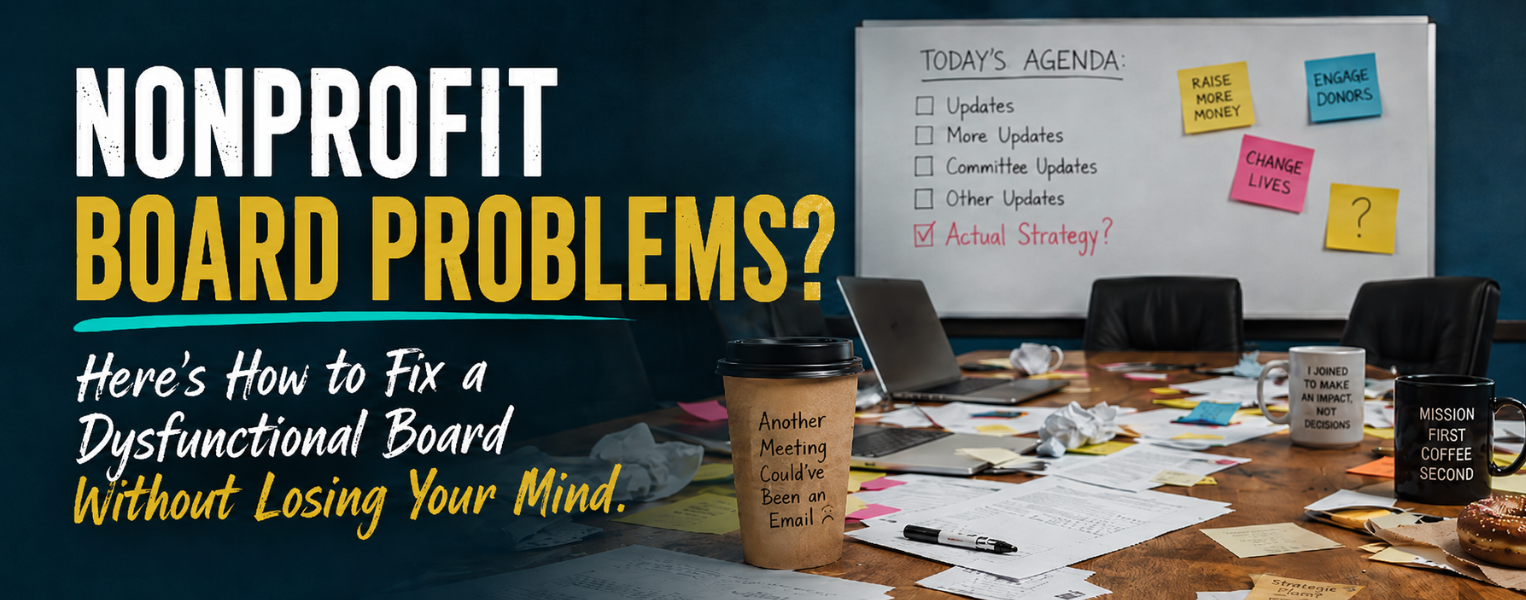
Nonprofit Board Problems: How to Fix a Dysfunctional Board Without Losing Your Mind
Let’s be honest for a second.
You did not start your nonprofit so you could spend every third Tuesday night sitting across from twelve people who do not know what they signed up for, debating whether to spend $79 on a new coffee maker for the break room.
And yet.
Here you are.
If your nonprofit board meetings feel more like hostage negotiations than strategic leadership sessions, you are not alone. Nonprofit board problems are everywhere.
Disengaged board members.
Confusion about roles.
Fear of fundraising.
Meetings that go nowhere.
Committees that exist in name only.
Board members who nod a lot but do very little.
It is exhausting.
But here is the good news: most dysfunctional nonprofit board issues are fixable.
The bad news? Fixing them requires someone to say out loud what is actually going wrong.
Consider this your permission slip.
FREE RESOURCES BELOW, BY THE WAY...
What Makes a Nonprofit Board Dysfunctional?
A dysfunctional nonprofit board is not always loud, dramatic, or openly hostile.
Sometimes it looks very polite.
Everyone smiles. Everyone approves the minutes. Everyone says they care deeply about the mission. Then nothing changes.
A nonprofit board becomes dysfunctional when board members are unclear about their responsibilities, avoid difficult conversations, fail to participate in fundraising, focus on operations instead of governance, or do not hold one another accountable.
In other words, the problem is not always bad people.
Sometimes the problem is a bad system.
Most board dysfunction comes from a few common issues:
- Board members were recruited without clear expectations.
- New members were never properly onboarded.
- The board does not understand governance.
- Fundraising expectations were never clearly explained.
- Meetings are focused on updates instead of strategy.
- There is no accountability for attendance or participation.
- The same people stay on the board too long.
- The executive director is carrying work the board should own.
If any of that sounds familiar, take a breath.
You are not alone. You are also not powerless.
Let’s fix the mess.
Problem #1: Board Members Do Not Understand Their Role
Somewhere along the way, someone told your board members their job was to attend meetings, nod thoughtfully, and approve the budget.
That person was wrong.
Nonprofit board members are fiduciaries. They are legally and ethically responsible for helping protect the organization’s mission, finances, reputation, and long-term health.
A strong nonprofit board helps with:
- Governance
- Financial oversight
- Strategic direction
- Executive director support
- Fundraising
- Community ambassadorship
- Risk management
- Mission accountability
That does not mean board members should manage staff, pick napkin colors for the gala, rewrite the newsletter, or hover over the executive director like a nervous drone.
That is not governance.
That is meddling with a name badge.
The board’s job is to lead at the right level. They should be focused on strategy, sustainability, oversight, and mission impact.
If your board members do not understand that, it usually means they were never properly taught.
That is not entirely their fault.
It is a recruitment, onboarding, and expectations problem.
How to Fix It
Start with a simple board expectations document.
Not a 14-page packet that disappears into a Google Drive folder and is never seen again.
A clear, direct, one-page document.
Include expectations around:
- Meeting attendance
- Committee participation
- Personal giving
- Fundraising support
- Community ambassadorship
- Confidentiality
- Preparation before meetings
- Strategic leadership
- Term limits
- Conflict of interest policies
Then review it with every current board member.
Not just new board members.
Everyone.
Have each board member sign it annually. Yes, even the longtime board member who has “been here since the beginning.” Especially that person, if we are being honest.
Some people will step up. Others may realize this is no longer the right role for them.
That is not a failure.
That is clarity.
And clarity is your friend.
Free Resource Help Solve This Problem:
Your board members cannot meet expectations that live only in your head. I'm sharing a free Board Member Expectations Template to clearly spell out what board members are responsible for, what support the organization will provide, and how everyone can start the year on the same page.
Download the FREE Board Member Expectations Template HERE
Problem #2: The Board Avoids Fundraising
This one is so common it should have its own support group.
Your board members say things like:
“I am not comfortable asking for money.”
“That is not my strength.”
“I do not know wealthy people.”
“I thought staff handled fundraising.”
“I did not join the board to ask my friends for money.”
Meanwhile, your organization is running on fumes and you are writing grant applications at midnight like some kind of nonprofit vampire.
Let’s be clear.
Board members do not need to be professional fundraisers to help with fundraising.
They do not need to cold-call strangers.
They do not need to beg.
They do not need to become slick salespeople.
They do not need to corner people at cocktail parties and ruin the cheese board.
But they do need to participate.
Board fundraising can include:
- Making introductions
- Thanking donors
- Sharing why the mission matters
- Inviting people to events
- Hosting small gatherings
- Identifying potential sponsors
- Calling lapsed donors
- Sharing campaigns on social media
- Making a personally meaningful gift
- Opening doors to businesses, civic leaders, or funders
Board fundraising is not just asking for money.
It is helping build relationships that lead to money.
That distinction matters.
How to Fix It
Stop telling your board, “We need you to help with fundraising.”
That is too vague.
Vague asks create vague results.
Instead, give board members specific, manageable actions.
Try this:
“Can you introduce me to three people who care about youth homelessness?”
“Can you make five thank-you calls this month?”
“Can you invite two people to our next site tour?”
“Can you share our campaign with a short note about why you serve on the board?”
“Can you help us identify five businesses that may want to sponsor the event?”
Now you are giving them something concrete.
Also, give them scripts.
Board members are often afraid because they do not know what to say. Do not make them invent language from scratch. That is how people panic and start saying weird things like, “Please donate because we are very nice.”
Give them talking points, sample emails, call scripts, and social media captions.
Make fundraising feel doable.
Because it is.
Want a deeper step-by-step guide? My book, How To Get Your Nonprofit Board To Fundraise, walks you through how to set expectations, train your board, and give members practical ways to support fundraising without making everyone feel awkward, guilty, or ready to fake a Wi-Fi outage. Get it on Amazon HERE.
Problem #3: Your Board Is Full of the Wrong People
Not everyone on your board should be on your board.
There. I said it.
Some people joined because they were enthusiastic three years ago. Some joined because they are friends with a founder. Some joined because they are connected to a major donor. Some joined because nobody else said yes.
And at least one person may be there because nobody had the heart to say no.
That is how nonprofit boards become crowded but not effective.
A strong board is not built by accident. It is built intentionally.
You need people with the skills, connections, lived experience, perspective, and commitment your organization needs now.
Not ten years ago.
Now.
This is not about being unkind.
It is about being responsible.
Your mission is too important to staff your board out of obligation.
How to Fix It
Create a board matrix.
A board matrix helps you identify what your board has, what it is missing, and what you should recruit for next.
Look at areas such as:
- Finance
- Legal
- Fundraising
- Marketing
- Human resources
- Programs
- Technology
- Facilities
- Public relations
- Government relations
- Community connections
- Lived experience
- Strategic planning
- Major donor access
- Corporate partnerships
Then ask the question most boards skip:
What does our organization need from its board over the next three years?
Not “Who do we know?”
Not “Who will say yes?”
Not “Who looks impressive on paper?”
Not “Who has a pulse and owns a blazer?”
Start with the organization’s needs and work backward.
That is how you recruit board members who can actually help lead.
Problem #4: Board Meetings Are Too Operational
If your board spends 25 minutes discussing where to store extra folding chairs but barely talks about financial sustainability, you have a problem.
Board meetings should not be staff meetings with fancier snacks.
They should not be a monthly tour through everything staff already did.
They should not be dominated by updates that could have been sent in an email.
Board meetings should focus on governance, strategy, oversight, and decisions.
If your board meetings are boring, unfocused, or painfully long, your agenda may be training board members to disengage.
And guess what?
They are learning.
How to Fix It
Redesign your board agenda.
A strong nonprofit board meeting agenda should focus on:
- Strategic decisions
- Financial trends
- Program outcomes
- Fundraising progress
- Board recruitment
- Risks and opportunities
- Executive director support
- Strategic plan progress
- Mission impact
- Long-term sustainability
Send reports in advance. Use a consent agenda when appropriate. Stop reading reports out loud unless your board enjoys bedtime stories with budget notes.
Make sure every major agenda item answers one of these questions:
- What decision do we need from the board?
- What strategic issue needs discussion?
- What risk does the board need to understand?
- What opportunity should the board help advance?
- What does this mean for our mission?
Your board members are more likely to act like leaders when the agenda invites them to lead.
Problem #5: Nobody Holds Board Members Accountable
This is where many nonprofit boards get stuck.
Everyone knows who misses meetings.
Everyone knows who never follows through.
Everyone knows who avoids fundraising.
Everyone knows who dominates conversations but does not actually do anything.
And everyone pretends not to know.
That silence is expensive.
When board members are allowed to miss meetings, ignore commitments, avoid fundraising, and remain on the board indefinitely, the message is clear:
Expectations are optional.
That is how strong board members get frustrated. It is also how weak board culture becomes normal.
How to Fix It
Create a board accountability process before you are in crisis.
This can include:
- Annual board self-assessments
- Board chair check-ins
- Attendance tracking
- Committee participation reviews
- Term limits
- Clear expectations for giving and fundraising
- A process for rotating inactive members off the board
Accountability does not have to be cruel.
Sometimes the conversation is simply:
“We are so grateful for your service. It seems like this may no longer be the right season for you to serve in this role. Would you be open to supporting the organization in another way?”
See?
Nobody died.
Awkward? Maybe.
Necessary? Absolutely.
Problem #6: The Executive Director Is Carrying the Board
This one is delicate, but we need to talk about it.
In many nonprofits, the executive director is doing the board’s job for them.
The executive director reminds board members to attend meetings.
The executive director creates the board agenda.
The executive director recruits board members.
The executive director drives fundraising.
The executive director follows up on committee work.
The executive director writes the strategic plan, updates the dashboard, manages the crisis, and probably orders the sandwiches.
Then everyone wonders why the executive director is exhausted.
A healthy nonprofit board should support the executive director, not become another program the executive director has to manage.
How to Fix It
Strengthen the board chair role.
The board chair should be the executive director’s partner in board leadership. That means the board chair helps set expectations, manage board culture, follow up with board members, lead difficult conversations, and keep the board focused on governance.
If the executive director is the only person holding the board accountable, the structure is broken.
Create a clear partnership between the executive director and board chair.
They should meet regularly to discuss:
- Board engagement
- Meeting agendas
- Fundraising participation
- Board recruitment
- Committee progress
- Executive director support
- Upcoming decisions
- Any board member concerns
The executive director should not have to carry the board alone.
That is not leadership.
That is a slow-motion burnout plan.
Free Resource Help Solve This Problem:
If any of that sounds familiar, start here: the Board Chair and ED Partnership Checklist gives you the role clarity table, the reset script, and the 30-day plan.
Download the FREE Board Chair and ED Partnership Checklist HERE
Problem #7: Board Recruitment Is Reactive, Not Strategic
Too many nonprofit boards recruit in panic mode.
Someone resigns. Everyone looks around the table. Someone says, “Does anyone know somebody?”
That is not a recruitment strategy.
That is a group project with snacks.
Reactive board recruitment leads to the same problem over and over again. You fill seats instead of building leadership.
You end up with people who are available, not necessarily people who are aligned.
How to Fix It
Create a year-round board recruitment process.
Strong boards are always cultivating future board members. They are not waiting until someone quits.
Build a simple pipeline:
- Identify the skills and connections you need.
- Ask current board members and staff for names.
- Invite prospects to events or tours.
- Have exploratory conversations.
- Share board expectations early.
- Ask candidates why the mission matters to them.
- Review fit before making an invitation.
- Onboard new members with intention.
And please, for the love of your mission, stop surprising people with board expectations after they join.
Tell them the truth up front.
Yes, we expect attendance.
Yes, we expect giving.
Yes, we expect fundraising participation.
Yes, we expect committee work.
Yes, we expect you to be an ambassador.
The right people will appreciate the clarity.
The wrong people will run.
Both are useful outcomes.
A Simple 30-Day Plan to Improve Your Nonprofit Board
You do not have to fix every nonprofit board problem overnight.
In fact, please do not try.
That is how you end up with a 47-page board improvement plan that everyone praises and no one implements.
Start with 30 days.
Week 1: Name the Real Problems
Meet with your board chair and executive director.
Ask:
- What is working well?
- What is not working?
- Where are board members confused?
- Where are we avoiding accountability?
- What are we expecting from the board that we have never clearly stated?
- What does the organization need from the board this year?
Be honest.
Not dramatic.
Honest.
Week 2: Create or Update Board Expectations
Draft a one-page board expectations document.
Include:
- Attendance expectations
- Giving expectations
- Fundraising participation
- Committee roles
- Ambassador responsibilities
- Preparation expectations
- Term limits
- Conflict of interest requirements
Then decide when and how you will review it with the full board.
Week 3: Redesign the Board Meeting Agenda
Look at your last three board agendas.
Ask:
- What could have been sent by email?
- What was operational instead of strategic?
- Where did the board actually make decisions?
- What important conversations are missing?
- Are we spending enough time on finances, fundraising, impact, and strategy?
Then create a better agenda for the next meeting.
Week 4: Assign Specific Fundraising Actions
Do not ask the board to “help with fundraising.”
Give them specific choices.
For example:
- Make thank-you calls.
- Invite people to a tour.
- Identify potential sponsors.
- Share a campaign.
- Make introductions.
- Attend donor meetings.
- Write personal notes.
- Help with follow-up after events.
Let board members choose from a menu of actions.
Then track follow-through.
That last part matters.
A plan without accountability is just a wish wearing business casual.
What a Healthy Nonprofit Board Looks Like
A healthy nonprofit board does not mean everyone agrees all the time.
It does not mean meetings are perfect.
It does not mean every board member is wealthy, connected, or naturally gifted at fundraising.
A healthy nonprofit board means:
- Board members understand their role.
- Expectations are clear.
- Meetings are strategic.
- Fundraising is shared.
- Board members follow through.
- The board chair leads.
- The executive director is supported.
- Recruitment is intentional.
- Accountability is normal.
- The mission stays at the center.
That is the goal.
Not perfection.
Progress.
Final Thought: Your Mission Deserves Better Than Board Chaos
If your nonprofit board is a hot mess right now, you are not doomed.
But you do have to stop pretending the mess will magically clean itself up.
It will not.
Board problems usually get worse when they are ignored.
The disengaged members get more disengaged.
The strong members get more frustrated.
The executive director gets more exhausted.
The mission pays the price.
So start small.
Name the problem.
Clarify the expectations.
Fix the agenda.
Train the board.
Recruit intentionally.
Have the hard conversations.
Your mission deserves a board that shows up for it.
Not just physically.
Fully.
Want Help Getting Your Nonprofit Board to Fundraise?
If you want a practical roadmap for transforming your board from a well-meaning collection of confused volunteers into an actual fundraising force, I wrote the book on it.
Literally.
How To Get Your Nonprofit Board To Fundraise is available on Amazon and walks you through how to recruit the right people, set clear expectations, build board confidence, and finally get your board doing the work they were always supposed to do.
Your mission deserves a board that understands the assignment.
Let’s get you there.
Frequently Asked Questions About Nonprofit Board Problems
What are the most common nonprofit board problems?
The most common nonprofit board problems include unclear roles, poor meeting attendance, weak fundraising participation, unproductive meetings, lack of accountability, poor recruitment, and board members who do not understand the difference between governance and management.
How do you fix a dysfunctional nonprofit board?
To fix a dysfunctional nonprofit board, start by identifying the specific problems. Then create clear board expectations, improve onboarding, redesign board meeting agendas, provide fundraising training, use a board matrix for recruitment, and create a process for board accountability.
What are the signs of a dysfunctional nonprofit board?
Signs of a dysfunctional nonprofit board include low attendance, poor follow-through, lack of fundraising participation, board members focusing on staff-level tasks, unclear roles, weak financial oversight, conflict avoidance, and meetings that do not lead to meaningful decisions.
What should nonprofit board members be responsible for?
Nonprofit board members are responsible for governance, financial oversight, strategic direction, executive director support, fundraising support, community ambassadorship, and protecting the mission of the organization. They are not responsible for managing daily operations unless the organization is an all-volunteer nonprofit.
Should nonprofit board members help with fundraising?
Yes. Nonprofit board members should help with fundraising, but that does not mean every board member has to directly ask for money. Board members can help by making introductions, thanking donors, inviting people to events, identifying prospects, sharing campaigns, and making a personally meaningful gift.
Why are nonprofit board members afraid of fundraising?
Many nonprofit board members are afraid of fundraising because they have not been trained, they think fundraising only means asking for money, or they feel uncomfortable talking about finances. Clear expectations, simple scripts, and specific fundraising tasks can help board members become more confident.
How can nonprofit boards improve meeting effectiveness?
Nonprofit boards can improve meeting effectiveness by using strategic agendas, sending reports in advance, limiting operational updates, focusing on key decisions, reviewing financial and program outcomes, and making space for meaningful discussion about the future of the organization.
What is the difference between nonprofit governance and management?
Governance is the board’s role. It includes oversight, strategy, financial accountability, and mission protection. Management is the staff’s role. It includes daily operations, program delivery, supervision, and implementation. Healthy nonprofits are clear about the difference.
How do you recruit better nonprofit board members?
To recruit better nonprofit board members, use a board matrix to identify the skills, relationships, experience, and perspectives your organization needs. Then recruit people who match those needs. Avoid filling board seats only with friends, familiar names, or people who simply say yes.
When should a nonprofit board member step down?
A nonprofit board member should step down when they can no longer attend meetings, fulfill expectations, participate meaningfully, support fundraising, or act in the best interests of the organization. Term limits and annual board check-ins make these transitions easier.
Affordable Nonprofit Digital Templates
_ad.avif)
Already done-for-you guides, documents, checklists, and templates for nonprofits!
Affordable Nonprofit Digital Templates
Already done-for-you guides, documents, checklists, and templates for nonprofits!


Get offers shipped right to your inbox
Stay up-to-date on the latest trends and strategies in the nonprofit sector. By subscribing, you'll gain access to valuable resources, educational content, and exclusive insights from an industry expert.